


When Should You Replace Suzuki Car Parts?
Knowing when to replace parts on your Suzuki is one of the most practical things you can understand as a vehicle owner. Replace too early and you waste money on components that still had useful life remaining. Replace too late and a worn part that should have been addressed quietly causes damage to adjacent systems, creates a safety risk, or fails at a moment when failure is most inconvenient and most expensive to resolve.
Suzuki vehicles, from the Jimny's legendary off-road capability to the Swift's city-friendly efficiency and the Vitara's versatile family appeal, have built a strong ownership base in the UAE. They are generally reliable vehicles that reward proper maintenance. Understanding the replacement intervals and warning signs specific to these models, in the context of the UAE's demanding climate, is the foundation of getting the most from them over a long ownership period.
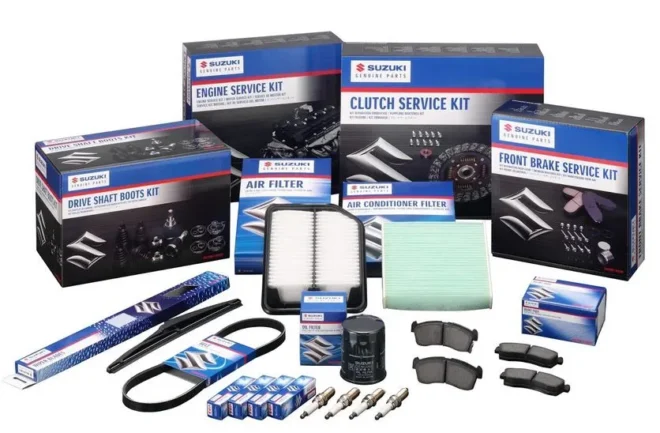
At Star City Autos, we supply suzuki spare parts from verified OEM supply chains serving the UAE market. Here is a practical guide to when the main component categories on Suzuki vehicles should be replaced and what tells you when the time has come.
Engine Oil and Filter: The Interval That Sets the Tone
Engine oil and oil filter replacement is the maintenance event that happens most often and that has the broadest impact on engine health. Everything else about how well you maintain a Suzuki begins here.
Suzuki specifies oil change intervals that vary by engine type and market, with many modern models pointing toward intervals of 10,000 to 15,000 kilometres under normal conditions. In the UAE, normal conditions do not apply in the same way. High ambient temperatures break down oil additive packages faster. Continuous air conditioning load increases the thermal load on the engine. Short trips in city traffic mean the oil never reaches the sustained operating temperature that burns off moisture and fuel dilution effectively.
The practical recommendation for UAE-based Suzuki owners is to treat the manufacturer's interval as a maximum and to consider more frequent changes during the summer months. Using the correct viscosity grade specified for your engine is not optional. Suzuki's smaller engines in particular have tight oil clearances that perform correctly with the specified viscosity and can develop wear issues faster with the wrong grade.
Air and Cabin Filters: Replace More Often Than the Manual Suggests
Air filter and cabin filter replacement intervals in Suzuki's service schedule are developed for moderate-climate conditions with controlled dust levels. Dubai's environment is neither.
Engine air filters in the UAE accumulate dust and sand at a significantly higher rate than the schedule anticipates, particularly during and after sandstorms or in areas with active construction. A saturated air filter reduces engine performance noticeably, increases fuel consumption, and in turbocharged models like the Vitara can affect turbo performance if dust loading collapses the filter media.
Check the air filter every 10,000 kilometres rather than waiting for the full replacement interval, and replace immediately if the filter is visibly loaded with dust rather than waiting for the next scheduled service.
Cabin filters deserve the same accelerated attention. In the UAE, the cabin filter works continuously as the AC runs through most of the year. A loaded cabin filter restricts airflow to the evaporator, reduces cooling effectiveness, and recirculates allergens inside the cabin when the media can no longer capture them. Every six months is a more realistic replacement interval than the annual schedule that temperate-climate maintenance assumes.
Brake Pads and Rotors: Safety-Critical and Traffic-Dependent
Brake pad wear rate is directly proportional to how a vehicle is driven and in what conditions. A Suzuki driven primarily on open highways in moderate traffic will wear brake pads significantly more slowly than one used daily in Dubai's stop-start city traffic, where braking events are frequent and sometimes abrupt.
Most Suzuki models have brake wear indicators that produce an audible squeal when pads approach minimum thickness. This is a notification to replace promptly, not a signal that a few more thousand kilometres are acceptable. Waiting beyond the wear indicator risks rotor damage from metal-to-metal contact, which turns a straightforward pad replacement into a more expensive pad-and-rotor job.
Inspect brake pad thickness during every service and replace when they reach 3mm or below rather than waiting for the wear indicator to activate. For UAE drivers who cover high annual mileage or drive frequently in heavy traffic, checking at 15,000-kilometre intervals rather than annual services makes practical sense.
Timing Belt or Chain: The Replacement You Cannot Afford to Miss
Timing belt replacement is one of the highest-stakes maintenance decisions in any Suzuki service schedule. Not all Suzuki models use a timing belt. The Swift and some Vitara variants use timing chains, which are generally longer-lived and do not require scheduled replacement. Models using timing belts, however, have a firm replacement interval that must be observed without exception.
A timing belt that fails causes the engine's valve and piston timing to lose synchronisation, almost always resulting in catastrophic engine damage that is among the most expensive repairs available on any vehicle. The timing belt is not a component that gives obvious warning of impending failure. It can appear intact visually and fail without notice.
Check your specific Suzuki model's service manual for the timing belt replacement interval, which is typically specified in both kilometres and years. In UAE conditions where heat accelerates rubber degradation, erring on the early side of this interval is sound practice.
Spark Plugs: Scheduled Replacement That Affects Everything
Petrol-engined Suzuki vehicles use iridium spark plugs with extended service lives, typically 60,000 to 100,000 kilometres depending on the engine. But extended life is not indefinite, and plugs that are past their service life cause starting difficulty, rough idling, reduced fuel economy, and in persistent misfires, catalytic converter damage that is considerably more expensive to address than the plugs themselves.
In UAE conditions where vehicles sit in high ambient temperatures and where shorter city trips mean engines spend proportionally more time warming up than cruising, spark plug condition deserves monitoring at major services rather than being ignored until the interval is reached.
Using genuine suzuki auto parts specification plugs is particularly important here. Suzuki specifies particular plug types and heat ranges for each engine, and using plugs with incorrect heat range characteristics can cause fouling in stop-start city driving or pre-ignition under sustained high-speed loads.
Coolant: The Fluid That Protects the Most Expensive Component
Coolant is often overlooked because it does not produce the immediate, visible symptoms that oil or brake fluid issues produce. But coolant that has degraded past its effective life is actively corroding the aluminium and iron components of the cooling system rather than protecting them.
Suzuki specifies coolant replacement at intervals that vary by model, typically every two to five years. In the UAE, where the cooling system operates at consistently high loads and where the thermal cycling the coolant experiences is more extreme than in temperate markets, leaning toward the shorter end of this interval is sensible.
Always top up and replace with the coolant type specified for your Suzuki. Mixing different coolant chemistries, even if both appear to be antifreeze, degrades the corrosion inhibitor effectiveness of both fluids and can accelerate internal corrosion.
Tyres: Condition and Age Matter Equally
Tyre replacement on a UAE-based Suzuki should be evaluated on two dimensions that are equally important: tread depth and tyre age.
Tread depth below 1.6mm is the legal minimum in the UAE, but 3mm is the practical safety threshold where wet-weather performance begins to decline noticeably. In the UAE where rain is rare but when it falls conditions are immediately challenging, maintaining adequate tread depth matters beyond the legal requirement.
Tyre age is equally critical in the UAE's UV-intense environment. UV radiation degrades tyre sidewall rubber faster here than in cooler climates, creating surface cracking and internal compound hardening even on tyres with adequate tread remaining. Tyres more than five years old should be inspected carefully for sidewall condition regardless of tread depth, and replacement at six to seven years is considered sound practice in the UAE regardless of apparent external condition.
Belts and Suspension Components: Inspect Proactively
The serpentine or accessory belt that drives the alternator, power steering pump, and AC compressor should be inspected at every major service for cracking, glazing, or fraying. Belt failure leaves the vehicle without electrical charging and power steering immediately, and in many models shuts down the cooling fan, creating an additional overheating risk.
Suspension components including shock absorbers, control arm bushings, and ball joints wear at a rate that reflects both mileage and road conditions. Shock absorber performance is worth testing at 80,000 kilometre intervals by observing whether the vehicle bounces more than once after a firm push on each corner. Bushings and ball joints that are developing play create handling imprecision and noise that the mechanic should assess during servicing.
Star City Autos supplies suzuki car parts covering all of the component categories discussed in this guide, with genuine OEM specification sourced from verified supply chains. For Suzuki owners in Dubai and across the UAE who want the confidence of the right part at the right time, we are here to support every maintenance decision your vehicle requires.
Final Thought
Knowing when to replace Suzuki parts is about understanding both the scheduled intervals and the signals that your specific vehicle in your specific operating conditions provides. In the UAE, those intervals are often shorter than temperate-market schedules suggest, and those signals deserve prompt attention rather than watchful waiting. Proactive replacement based on the right components keeps the vehicle performing as it was built to perform and avoids the compounding cost of deferred maintenance catching up at once. Star City Autos is here to make that straightforward.
Frequently Asked Questions
How often should engine oil be changed in a Suzuki in the UAE?
Treat the manufacturer's interval as a maximum and consider changes every 5,000 to 7,500 kilometres during summer months in Dubai, using the correct viscosity grade specified for your engine variant.
Howdo I know if my Suzuki's timing belt needs replacement?
Check the service manual for the specific interval in both kilometres and years. Do not wait for symptoms as timing belts rarely give warning before failure. In UAE conditions, replace at or slightly before the specified interval rather than extending beyond it.
What is the right tyre replacement interval for Suzuki vehicles in Dubai?
Replace tyres when tread depth reaches 3mm for safety purposes, and inspect sidewall condition on any tyre over five years old regardless of tread depth. UV degradation in Dubai's climate can compromise tyre integrity before tread wear becomes the limiting factor.
Are genuine Suzuki parts worth the higher upfront cost in the UAE?
Yes. Genuine parts are specified and validated for the thermal and mechanical demands of the vehicle they serve, deliver longer service life, and preserve warranty coverage, resulting in lower total maintenance cost over the ownership period.
Does Star City Autos stock Suzuki parts for all models available in the UAE?
Yes. Star City Autos maintains inventory across the full Suzuki model range in the UAE market including the Jimny, Swift, Vitara, Ciaz, and Grand Vitara, sourced through verified OEM supply chains covering all major component categories.